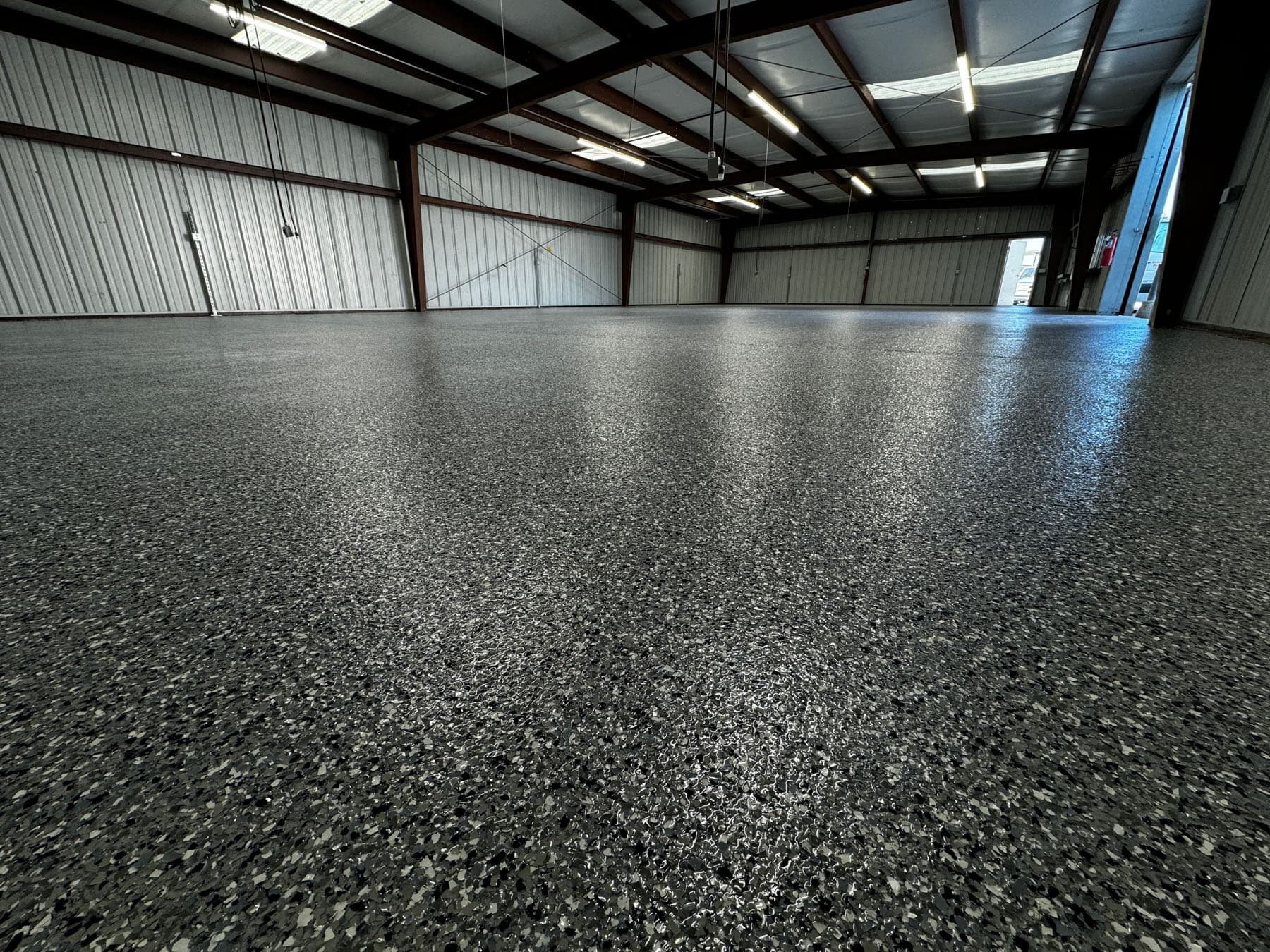
Commercial epoxy flooring for Kamloops businesses
Commercial floors take real punishment. Heavy foot traffic, rolling carts, constant cleaning, and the occasional forklift or pallet jack — your floor needs to handle all of it while still looking professional. We install commercial epoxy flooring systems for retail spaces, offices, showrooms, warehouses, and light industrial facilities throughout Kamloops and the Thompson Okanagan.
What's included
- Full slab assessment, moisture testing, and condition report
- Diamond grinding or shot blasting to proper surface profile
- Crack repair and surface leveling
- High-build commercial epoxy base coat system
- Chemical-resistant polyurea or polyaspartic topcoat
- Slip-resistant finish option for high-traffic and wet areas
- Safety line marking and zone designation (optional)
- Section-by-section scheduling to minimize business downtime
When you need this service
New commercial space being fit-out and ready for flooring
Existing floor that's cracking, staining, flaking, or failing
Retail or showroom wanting a clean, professional look
Office or light commercial space needing a durable, easy-clean floor
Our process
Free site visit: we look at the floor, check moisture, assess traffic and use, and talk through options
Proposal with system specs, timeline, and section-by-section schedule
Diamond grind or shot blast to open the surface for proper adhesion
Repair cracks, spalls, and surface damage
Apply commercial epoxy base coat in the specified build
Apply topcoat: chemical-resistant polyurea or polyaspartic to spec
Install line marking and safety zones if required
Handover with maintenance guide and cure schedule
Why choose Elite Epoxy for commercial epoxy flooring
- We schedule around your operation — nights, weekends, and section-by-section installs
- Commercial-grade systems, not the same product we'd use in a residential garage
- Moisture tested before every job — the leading cause of commercial floor failures
- Safety line marking integrated into the install, not painted on top after the fact
- We've done commercial epoxy flooring in Kamloops retail, office, warehouse, and service environments
We install commercial epoxy flooring throughout Kamloops and the surrounding Thompson Okanagan region. See all areas we serve →
What commercial epoxy flooring actually means
The term 'commercial epoxy flooring' covers a wide range. A boutique retail store and a busy distribution warehouse both qualify as commercial — but they need very different floor systems. The spec that makes sense for a showroom is not the same as one that handles a pallet jack running over it 200 times a day.
When we say commercial epoxy flooring, we mean floor coating systems specified and installed for non-residential use: higher traffic volumes than a home, more frequent cleaning, greater exposure to chemicals and abrasion, and often regulatory requirements around slip resistance and safety marking. Here's how the main commercial categories break down:
- Retail and showroom. Appearance matters as much as durability. We typically spec a decorative flake or solid-colour system with a high-gloss polyaspartic topcoat. The floor reflects light, makes the space feel larger, and holds up to shopping cart wheels and foot traffic without showing wear.
- Office and light commercial. Lower traffic, more focus on cleanliness and appearance. A solid-colour or quartz system with a satin or semi-gloss finish is usually right. Fast cure means minimal disruption to the office schedule.
- Restaurant and food service. Needs a non-porous, slip-resistant surface that holds up to kitchen cleaning chemicals, grease, hot water, and constant foot traffic. We use systems rated for food-service environments with textured, non-slip aggregate in high-risk areas.
- Warehouse and distribution. Higher build requirements, greater abrasion resistance, and often safety line marking. Depending on the traffic load, we step up to a self-leveling high-build system rather than a standard commercial coat.
- Service facilities and auto shops. Chemical resistance from oils, fuels, and solvents takes priority. These sit closer to industrial spec than retail commercial.
Technical DetailChoosing the right system for your commercial space
We ask a few key questions before we spec a commercial floor:
- What's the foot and vehicle traffic volume? Light foot traffic (office, boutique) vs. moderate (busy retail, restaurant) vs. heavy (warehouse, service bay) drives the base coat build and topcoat selection.
- What chemical exposure does the floor see? Water and standard cleaners are one category. Kitchen degreasers, acids, and solvents are another. The topcoat spec changes accordingly.
- What slip resistance is required? WorkSafeBC requires specific COF (coefficient of friction) values in wet commercial environments. We can hit any target with the right aggregate broadcast density.
- How much downtime can you absorb? Polyaspartic topcoats cure in 4–6 hours. A well-scheduled section-by-section install can keep your business operational throughout. We plan the sequence with you.
- Is there a specific aesthetic requirement? Corporate branding colours, logo inlays, zone colour coding — we incorporate these into the install, not as an afterthought.
The answers shape the spec. We don't have a single 'commercial package' because one package doesn't fit every commercial space.
Technical DetailMoisture and commercial slab prep: what most contractors skip
Commercial slab failures are overwhelmingly moisture-related. A ground-floor retail slab, a restaurant kitchen floor, or a warehouse on a slab-on-grade — all of these are at risk of moisture vapor emission pushing the coating off from underneath. The failure looks like blistering, bubbling, or the coating lifting in sheets. It happens months after install, not immediately, which is why it's often blamed on the product rather than the prep.
We test every commercial slab before we coat it. We use calcium chloride kits per ASTM F1869 and, for high-value or high-stakes installs, in-slab relative humidity probes per ASTM F2170. Slabs above 3 lbs MVER get a vapor-mitigating primer — not a standard primer applied thicker.
Surface prep follows the moisture assessment. For most commercial floors we diamond grind to CSP 2–3. For higher-build systems or heavily contaminated slabs, we step up to shot blasting. Existing coatings, sealers, adhesive residue from old floor tiles, and surface laitance all come off before anything new goes down.
Slip resistance in commercial epoxy flooring
Slip and fall incidents are the leading cause of commercial liability claims in BC. WorkSafeBC guidelines reference ASTM E1679 and similar standards for pedestrian slip resistance. A high-gloss epoxy floor in a dry retail environment is generally fine. The same floor in a restaurant kitchen, entrance vestibule, or commercial washroom area is not.
We match the slip resistance spec to the use case:
- Dry commercial areas (offices, retail): standard polyaspartic topcoat, typically 0.5+ COF dry
- Wet or contaminated areas (kitchens, service bays, vestibules): anti-slip aggregate broadcast into the topcoat to achieve 0.6+ COF wet
- High-risk wet areas (commercial kitchens, food processing): coarser aggregate profile for 0.8+ COF wet, confirmed with a slip meter if required
We can document the slip resistance of any floor we install. If your insurer or inspector needs a number, we can provide it.
Scheduling commercial epoxy flooring around your business
Most commercial clients can't shut down for two days. We plan around that from the start:
- Section-by-section scheduling: we divide the floor into zones and complete one zone at a time. The rest of the space stays operational.
- Polyaspartic topcoats cure in 4–6 hours, meaning a zone completed at 7am is back in light-traffic service by noon.
- We work evenings and weekends for businesses that can't absorb any daytime downtime.
- For restaurants and food service, we coordinate around service hours and health inspection schedules.
Before we start, we give you a written schedule showing which zones go down on which days and when each section is back in service. No surprises.
Common commercial spaces we've done in Kamloops
We've installed commercial epoxy flooring in a range of Kamloops business types. Each one gets a spec built for how that space actually operates:
- Retail stores and boutiques: decorative flake or solid colour systems with high-gloss polyaspartic topcoat
- Restaurants and commercial kitchens: anti-slip systems rated for kitchen chemical exposure, with coved bases in prep areas
- Offices and professional spaces: clean solid-colour or quartz systems, minimal disruption scheduling
- Showrooms and dealerships: high-gloss, reflective floors that show off product
- Gyms and fitness studios: shock-absorbent broadcast systems or solid colour with anti-slip aggregate
- Warehouses and distribution centres: high-build self-leveling systems with line marking
If your business type isn't on that list, give us a call anyway. We'll tell you straight whether epoxy is right for your space and what the right system looks like.
Common epoxy floor questions
Everything you want to know about epoxy floors before picking up the phone.
A professionally installed epoxy floor typically lasts 10–20 years with normal use. Garage floors in harsh climates like Kamloops can expect 10–15 years with proper maintenance.
Your epoxy floor won't
coat itself.
Call us or fill out the form and we'll get back to you the same day. Free on-site quotes with no obligation.