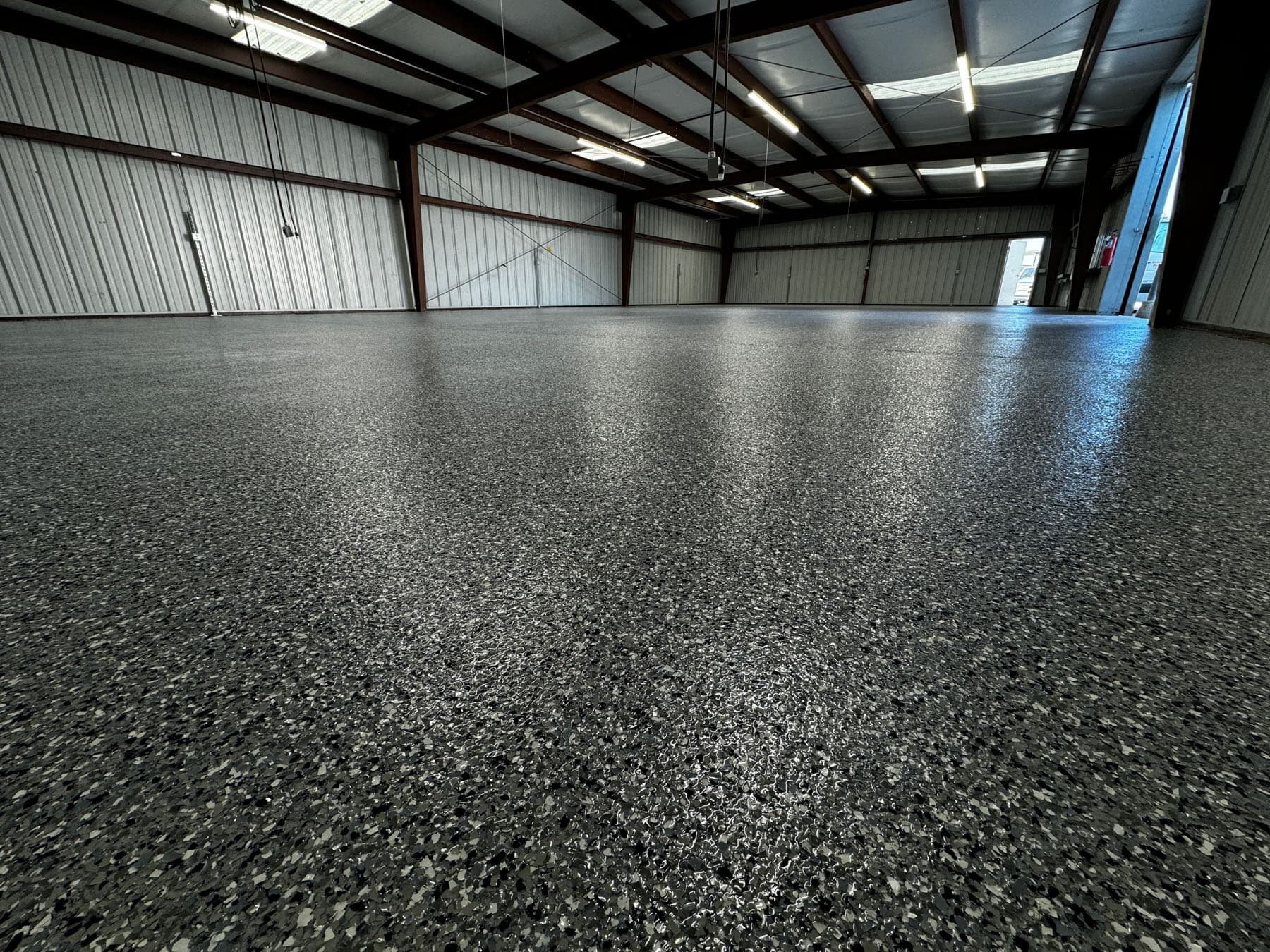
Industrial epoxy flooring for Kamloops warehouses, shops & facilities
When the floor has to handle forklifts, chemical spills, heavy point loads, and daily industrial traffic, a standard epoxy coat isn't going to cut it. Our industrial epoxy flooring systems are high-build, chemical-resistant, and engineered for the real demands of manufacturing, automotive, cold storage, and warehouse environments in Kamloops and the Thompson Okanagan.
What's included
- Full slab inspection: structural assessment, moisture testing, and crack classification
- Shot blasting or diamond grinding to open the surface properly
- High-build epoxy mortar or self-leveling base coat (3–6mm total build)
- Chemical-resistant polyurea or polyaspartic topcoat
- Cove base and floor-to-wall transition for hygienic areas
- Safety line marking, zone colours, and directional arrows
- Section-by-section scheduling to minimize operational downtime
When you need this service
Warehouse or distribution centre with forklift and pallet jack traffic
Manufacturing or production facility with chemical or fluid exposure
Automotive shop, body shop, or vehicle service facility
Cold storage, food processing, or commercial kitchen floor
Our process
Site visit and slab assessment: we look at load requirements, chemical exposures, moisture, and existing surface conditions
System selection based on your facility's specific demands — not a one-size solution
Schedule install in sections to keep your operation running during the job
Shot blast or diamond grind to the correct surface profile for the specified system
Apply epoxy mortar or self-leveling base coat in the required build thickness
Apply chemical-resistant topcoat with appropriate slip resistance
Line marking, safety zones, and any regulatory markings
Handover with maintenance guide and cure schedule
Why choose Elite Epoxy for industrial epoxy flooring
- We spec the system to your chemical exposure and load requirements — not just what's fastest to install
- High-build mortar systems rated for forklift traffic and heavy point loads
- Hygienic coved base available for food-grade and pharmaceutical areas
- Section-by-section scheduling minimizes downtime
- Safety line marking and zone designation included
- Industrial experience in warehouses, automotive shops, and manufacturing throughout Kamloops
We install industrial epoxy flooring throughout Kamloops and the surrounding Thompson Okanagan region. See all areas we serve →
What is industrial epoxy flooring?
Industrial epoxy flooring is a high-build floor coating system engineered for demanding environments where standard coatings fail. Unlike a residential garage epoxy (typically 16–20 mils total), an industrial epoxy system builds up 3–6mm of material on the slab — combining an epoxy mortar base, one or more self-leveling mid-coats, and a chemical-resistant polyurea or polyaspartic topcoat.
The extra thickness is what allows industrial floors to handle what residential coatings can't: point loads from forklift tines, repeated thermal cycling in cold storage, chemical exposure from oils, solvents, acids, and caustic cleaners, and the constant abrasion of pallet jacks, carts, and steel-toe boots over millions of square feet of use.
We install industrial epoxy flooring for warehouses, manufacturing plants, automotive facilities, body shops, food processing areas, and anywhere a floor needs to perform under real industrial conditions. The chemistry is more demanding, the prep requirements are stricter, and the stakes are higher — a floor failure in a production facility costs a lot more than a floor failure in a garage.
Technical DetailIndustrial epoxy systems: matching the product to the facility
Not every industrial facility needs the same system. Here's how we approach it:
- Standard warehouse (forklift traffic, dry goods, light chemical exposure). A 2–3mm self-leveling epoxy system with a polyurea topcoat handles this well. We target 8–12 mils per coat over a well-prepped slab. Cures fast enough to section-install without multi-day shutdowns.
- Automotive shop or body shop (oil, fuel, brake fluid, solvent exposure). Needs a chemical-resistant topcoat rated for hydrocarbon and solvent contact. We typically spec a high-build novolac epoxy or a polyurea topcoat with documented chemical resistance data for the specific fluids present.
- Food processing or commercial kitchen (frequent wash-downs, caustic cleaners, thermal shock). A coved floor-to-wall transition is required so there are no joints for bacteria to harbour. The system needs to be rated for commercial cleaning chemicals and thermal cycling from steam cleaning. We use FDA-compliant systems where required.
- Cold storage and refrigerated facilities (freeze-thaw, condensation, temperature differentials). The substrate is the main challenge: cold slabs behave differently during cure, and moisture vapor from the slab is elevated. We use low-temperature-cure epoxy systems and address moisture before any coating goes down.
- Manufacturing with heavy equipment (forklifts, presses, heavy racking loads). High-build epoxy mortar (6mm+) is the floor here. It fills and levels surface damage while building the thickness needed to distribute heavy point loads. Broadcast aggregate in the topcoat adds grip for high-traffic paths.
What is the best epoxy for industrial warehouses?
For most Kamloops warehouses, we specify a 100% solids self-leveling epoxy base system (two coats at 8–12 mils DFT each) paired with an aliphatic polyurea or polyaspartic topcoat rated for abrasion and chemical resistance. 100% solids formulations don't contain solvents, which means no outgassing issues during cure, no VOC concerns indoors, and the full wet film becomes dry film — you get what you pay for in thickness.
That said, the 'best' system depends on what your warehouse actually sees. A dry goods facility with standard electric forklifts has different requirements than a maintenance shop where fuel and oil are on the floor daily. We look at:
- Load type: pallet jacks and electric forklifts vs. propane forklifts vs. heavy equipment
- Chemical exposure: oils, fuels, solvents, acids, caustics, or just water and standard cleaning agents
- Thermal exposure: ambient temperature, steam cleaning, cold storage cycling
- Slip resistance requirements: dry warehouse vs. areas that get wet regularly
- Regulatory requirements: food-grade compliance, safety marking obligations
We specify the system that meets those requirements. If a lighter system genuinely handles your facility's demands, we'll recommend that over something more expensive than your floor needs.
Technical DetailSubstrate prep for industrial floors: stricter than residential
Industrial floors get prepped more aggressively than residential floors, for good reason. The loads are higher, the chemical exposure is greater, and a bond failure in a production environment shuts things down. Here's what changes:
- Shot blasting vs. diamond grinding. For most industrial applications we prefer shot blasting over diamond grinding. Shot blasting propels small steel shot at the surface at high velocity, removing contamination and creating a more uniform CSP 4–6 surface profile (compared to CSP 2–3 for residential). The deeper profile means more mechanical interlock between the epoxy and the concrete. It's also faster on large areas.
- Oil and fuel contamination. Industrial slabs often have years of oil soaked into the surface. Standard grinding doesn't remove it — it redistributes it. We treat heavily contaminated slabs with degreaser and, where needed, heat treat the surface to draw out embedded hydrocarbons before grinding. Skipping this step is a guaranteed delamination.
- Moisture vapor: higher stakes. Industrial slabs are often thicker and may sit directly on compacted gravel with no vapour barrier. We always test MVER per ASTM F1869. For slabs above threshold we install a moisture-mitigating primer system, not just a standard primer.
- Crack and joint treatment. Control joints and expansion joints in industrial slabs need semi-rigid polyurea filler rather than rigid epoxy — the floor moves, and a rigid fill cracks. We match the filler to the joint type.
Line marking, safety zones, and compliance
WorkSafeBC requires clear floor marking in most industrial environments: pedestrian walkways separated from vehicle lanes, forklift charging zones, emergency exits, hazardous storage areas. We apply line marking as part of the floor installation — not as an afterthought with paint over a cured floor.
Marking applied to the floor before the final topcoat goes down is locked into the system and lasts as long as the floor. Surface-applied marking wears off under forklift traffic inside a year. We integrate it into the build.
- Standard line widths: 100mm (4 in.) for pedestrian lanes, 150mm (6 in.) for vehicle and forklift lanes
- Colour coding: yellow for walkways, white for storage zones, red for hazardous areas, blue for maintenance zones
- Directional arrows and text as required
- High-build epoxy or polyurea line material — not paint
Minimizing downtime during installation
We know you can't shut down a facility for three days. We plan installations around your operation, not the other way around:
- Section-by-section scheduling: we divide the floor into zones and install one zone at a time, keeping the rest of the facility operational
- Polyurea and polyaspartic topcoats cure in 4–6 hours, meaning a zone done in the morning is back in light service by end of shift
- We work weekends and nights when required to minimize impact on production
- We coordinate with your facility manager to sequence the work around shift patterns and material handling needs
If you're in Kamloops or the Thompson Okanagan and need a warehouse, shop, or facility floor assessed, give us a call. We'll come out, look at the slab, and tell you straight what system your facility needs and how we can schedule the work.
Common epoxy floor questions
Everything you want to know about epoxy floors before picking up the phone.
A professionally installed epoxy floor typically lasts 10–20 years with normal use. Garage floors in harsh climates like Kamloops can expect 10–15 years with proper maintenance.
Your epoxy floor won't
coat itself.
Call us or fill out the form and we'll get back to you the same day. Free on-site quotes with no obligation.