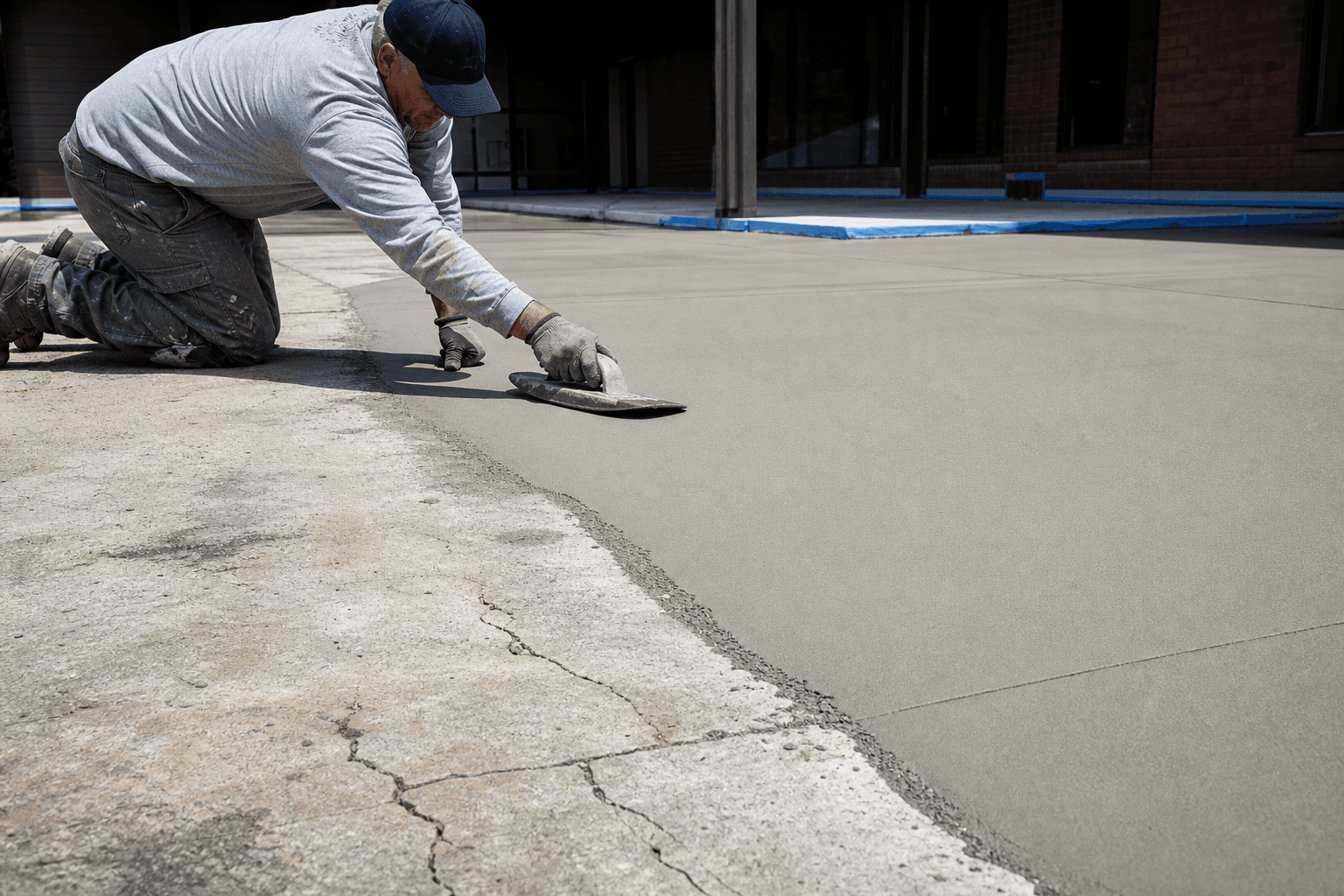
Epoxy Floor Repair
in Kamloops, BC
A failing epoxy floor coating doesn't always need to be completely redone — but it does need to be properly fixed, not just patched over. Cracks, spalls, delamination, and coating failures have root causes. Patching over a coating that failed without fixing the underlying problem just means you're paying for two failed coatings. We diagnose what actually went wrong, fix it at the root, and install a system that doesn't repeat the same mistake.
What's included
- Full floor assessment and failure mode diagnosis
- Removal of failed coating sections where required
- Concrete crack routing and filling
- Spall and delamination repair
- Surface re-prep to required profile for new coating adhesion
- Moisture vapor testing if delamination is moisture-related
- New coating system matched to corrected substrate and use case
When you need this service
Existing epoxy or polyaspartic coating that's peeling, bubbling, or lifting
Concrete floor with cracks, spalls, or surface damage from impact or chemical exposure
Coating that was applied over an improperly prepped or moisture-affected slab and is failing
Floor that needs partial repair and recoating to extend its service life
Our process
Floor inspection: we assess every failure point, test for moisture if delamination is present, and identify the root cause
Remove failed coating sections as required — we don't try to bond new coating to delaminated old coating
Address the root cause: moisture mitigation, contamination removal, re-grinding to solid concrete
Fill and repair cracks, spalls, and voids
Apply new coating system that matches the corrected slab and the use case
Inspect and walk through the repaired floor
Why choose Elite Epoxy for epoxy floor repair
- We diagnose the failure before recommending a repair — the fix depends on the cause
- Honest assessment: we'll tell you if repair is worth it or if a full replacement is better value
- We address root causes — not just recoat over a problem that will fail again
- Colour-match capability for partial repairs where the rest of the floor is in good condition
- Same prep standards on repairs as on new installs — there's no shortcut version
We install epoxy floor repair throughout Kamloops and the surrounding Thompson Okanagan region. See all areas we serve →
Why epoxy floors fail: the actual causes
The vast majority of epoxy floor failures — the peeling, bubbling, and delamination that drive people to call us — are not product failures. The chemistry of commercial epoxy systems is reliable. What fails is the application, and the most common application failures are: insufficient surface preparation, unaddressed moisture vapor emission, applying the wrong product for the application, and inadequate cure conditions.
Insufficient surface prep is the most common cause. Epoxy that was applied over a floor that wasn't diamond-ground — or was only superficially cleaned — bonds to the weak surface layer (laitance) of the concrete rather than to the concrete itself. When that weak layer separates under thermal cycling, moisture, or mechanical stress, the coating goes with it. This looks like large sheets lifting cleanly off the slab, often with the grey surface paste still stuck to the back of the peeling coating.
Moisture vapor emission is the second most common cause. Concrete slabs constantly emit moisture vapor, especially slabs without a vapour barrier or in below-grade applications. When that vapor pressure builds under a coating, it pushes the coating off from below — the failure manifests as blisters, bubbles, or lifting edges. The coating itself can look perfectly good except for the delaminated areas. This failure is almost always preventable with a moisture test and the appropriate primer system.
Chemical damage, impact damage, and coating age are other causes, but they're far less common than the prep and moisture failures described above. When we assess a failing floor, we start with those two root causes first.
What we can repair vs. what needs full replacement
Not every failing floor is worth repairing. Sometimes a full strip-and-recoat is better value than patching a floor with multiple failure points spread across the slab. We assess this honestly and give you our recommendation based on the extent of the failure, the condition of the underlying concrete, and the cost comparison between repair and full replacement.
Repair makes sense when: the failure is localized (specific areas of delamination or cracking while the rest of the floor is sound), the root cause is addressable (isolated moisture issue, specific impact damage, edge lifting without full-floor involvement), and the rest of the coating is still in good condition and well-bonded. In these cases, targeted repair and recoat of the affected sections is cost-effective and gives a good result.
Full replacement makes more sense when: the failure is widespread (large portions of the floor are delaminating or the adhesion is compromised across the slab), the root cause is a slab-wide problem (high moisture vapor emission across the whole floor, general laitance from insufficient original prep), or the existing coating is simply old and at the end of its service life. In these cases, we strip the failed system back to concrete, address the root issue, and install a new system with a proper baseline.
Technical DetailThe repair process: why 'patch and go' doesn't work
A common approach to failing epoxy floors is to grind back the delaminated edges, apply a fresh coat over the affected area, and call it done. This is 'patch and go', and it consistently fails for the same reason the original coating failed — the root cause hasn't been addressed.
If moisture vapor caused the original delamination, patching over the same slab without a vapor-mitigating primer means the moisture is still there, still building pressure. The patch delaminates on the same timeline as the original coating. If insufficient prep caused the failure, grinding just the edges of the delaminated area and patching doesn't address the adhesion quality of the surrounding coating — the failure continues to spread at the edges of the patch.
Proper epoxy floor repair addresses the root cause first. If moisture is the issue, we test the slab, remove the failed areas, and apply a moisture-mitigating primer to the exposed concrete before recoating. If insufficient prep is the cause, we diamond grind the failed areas back to clean concrete with proper surface profile. We then apply the repair coating to a properly prepared substrate — the same way we'd apply it on a new job.
Common epoxy floor questions
Everything you want to know about epoxy floors before picking up the phone.
A professionally installed epoxy floor typically lasts 10–20 years with normal use. Garage floors in harsh climates like Kamloops can expect 10–15 years with proper maintenance.
Your epoxy floor won't
coat itself.
Call us or fill out the form and we'll get back to you the same day. Free on-site quotes with no obligation.