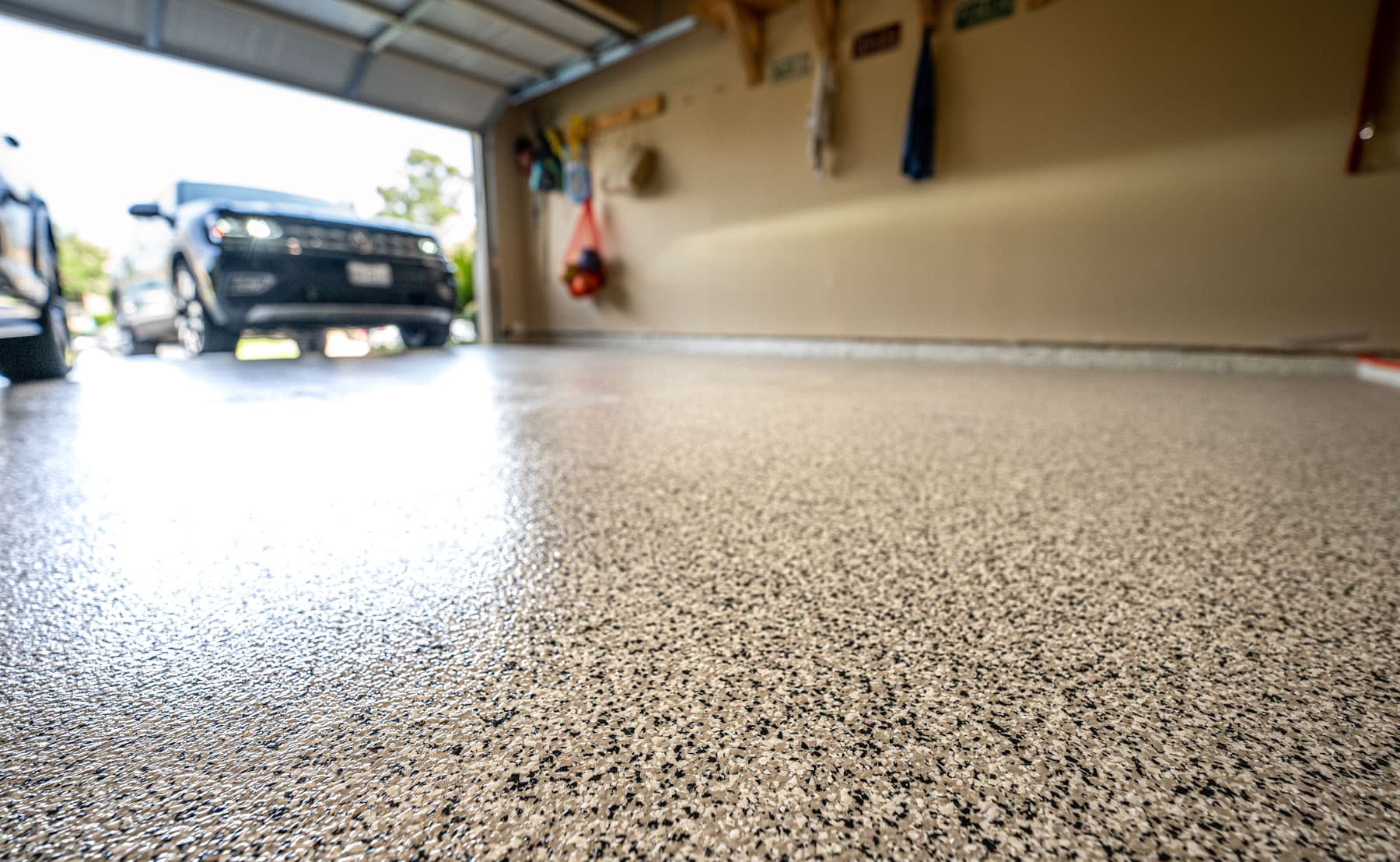
The leading garage floor epoxy company in Kamloops, BC
Kamloops's go-to garage floor epoxy company for residential and commercial installs. We coat garage slabs with commercial-grade epoxy systems, properly prepped, properly applied, built to survive BC Interior winters. If you've seen a garage floor epoxy fail in two years, it peeled because the prep was skipped. We don't skip prep.
What's included
- Diamond grinding for a true mechanical bond (CSP 2–3 profile)
- Crack routing, spall repair, and low-spot leveling
- Moisture vapor assessment before coating
- High-build epoxy base coat (8–12 mils DFT)
- Full-rejection vinyl flake broadcast (optional)
- UV-stable aliphatic polyaspartic topcoat (3–4 mils DFT)
- Anti-slip aggregate finish
When you need this service
New garage slab ready for its first coating
Existing coating that's peeling, flaking, or failing
Concrete that's stained, pitted, oil-soaked, or bare
Workshop or garage you want bright, clean, and easy to maintain
Our process
Free on-site inspection: we look at the slab, check for moisture, and talk through your options
Diamond grind to CSP 2–3 profile — this is what makes the epoxy stick
Route and fill all cracks, repair spalls, level low spots
Apply penetrating primer and epoxy base coat
Broadcast decorative flake to rejection (if chosen)
Apply UV-stable polyaspartic topcoat with anti-slip aggregate
Walk-through — you see the finished floor before we pack up
Why choose Elite Epoxy for garage floor epoxy
- We grind every floor — no acid-wash shortcuts, ever
- Aliphatic polyaspartic topcoat: UV-stable and cold-cure-rated to -20°C
- Foot traffic in 6–8 hours, vehicles at 24 hours
- Full flake and colour selection brought on-site
- No sub-contractors — same crew from quote to cleanup
- Moisture tested before every job so we catch problems before they become yours
We install garage floor epoxy throughout Kamloops and the surrounding Thompson Okanagan region. See all areas we serve →
What a proper garage floor epoxy job actually looks like
Most peeling epoxy floors in Kamloops have one thing in common: the slab wasn't ground. The installer skipped mechanical prep, used an acid wash or a quick scuff, and brushed on a coat. Four winters later the floor is lifting in sheets because epoxy has no real bond to a surface that wasn't opened up properly.
On every job we run, a planetary diamond grinder goes on the slab first. Grinding opens the concrete's pore structure so epoxy can penetrate and form a mechanical bond, not just sit on the surface. It also removes laitance (the weak, dusty layer that forms when concrete finishes curing), old sealers, tire marks, and oil contamination. We target a Concrete Surface Profile of CSP 2–3, roughly the feel of fine sandpaper. That's the spec most commercial epoxy manufacturers require for a warranted install.
After grinding, we vacuum thoroughly and walk the entire slab. Cracks get chased and filled with epoxy filler. Low spots get leveled. Any spalling gets repaired. The coating only goes on when the substrate is ready. That's the whole job, done right.
Technical DetailSystem build-up and coating thickness
A professional garage floor epoxy system isn't a single coat. Here's what goes on your slab and why each layer matters:
- 1Penetrating primer (2–4 mils dry film thickness). Seals micro-pores, begins the chemical bond, and reduces outgassing from the slab.
- 2High-build epoxy base coat (8–12 mils DFT). The structural layer. Adds thickness, creates the colour base, and distributes stress across the slab surface.
- 3Full-rejection vinyl flake broadcast (if chosen). Flake is broadcast until the base coat can't accept more. The flake layer hides minor surface variation, adds texture, and gives the topcoat a mechanical grip surface.
- 4Aliphatic polyaspartic topcoat (3–4 mils DFT). The wear surface. Scratch-resistant, UV-stable, chemical-resistant, and flexible enough to handle thermal movement.
Total dry film thickness for a standard flake system: 16–20 mils, or roughly 400–500 microns (about half a millimetre). Most hardware-store garage floor kits apply at 2–4 mils total. That's one-fifth the thickness. The difference in durability is not subtle.
Technical DetailWhy we use polyaspartic topcoats, not standard epoxy or urethane
We specify aliphatic polyaspartic resins for topcoats on every garage floor epoxy job. Three reasons:
- UV stability. Standard aromatic epoxy topcoats yellow within months of UV exposure. Polyaspartic is an aliphatic resin, meaning its chemistry doesn't break down in sunlight. Garage doors open. Kamloops gets 300-plus days of sun annually. You need a topcoat that stays clear.
- Cold-weather cure. Standard epoxy needs slab temperatures above 10°C to cure correctly. Below that, cure slows, adhesion suffers, and you end up with a soft, underperforming layer. Polyaspartic cures reliably down to -20°C. We can install in a Kamloops garage in late October. Most companies can't.
- Surface hardness. Polyaspartic topcoats typically test at 75+ Shore D hardness. Standard epoxy finishes sit at 65–70 Shore D. A harder surface resists abrasion, dropped tools, scraping ice off vehicles, and hot-tire pickup better.
Technical DetailSubstrate assessment: what we check before we ever start grinding
A coating is only as good as what it's stuck to. Before we quote any garage floor, we assess four things:
- Moisture vapor emissions. Concrete slabs emit moisture vapor, especially slabs without a vapour barrier underneath (common in older Kamloops garages). High vapor emission pressure builds up under a coating and causes osmotic blistering. We test using calcium chloride kits (per ASTM F1869) or in-slab relative humidity probes (ASTM F2170). Slabs exceeding 3 lbs per 1,000 sq ft per 24 hours need a vapor-mitigating primer before topcoating.
- Surface compressive strength. Standard residential garage slabs pour at 3,000–4,000 PSI compressive strength. If a slab tests soft (you can scratch powdery material off the surface easily), it may need a concrete densifier before the epoxy system goes down.
- Existing sealers or coatings. A sealer on the surface breaks the bond between epoxy and concrete. We run a water drop test before grinding — if water beads, there's a sealer. We grind through it. Coating over an existing sealer is a predictable failure.
- Crack classification. Hairline shrinkage cracks are normal concrete behaviour and we chase and fill them with epoxy filler. Structural cracks (wider than 6mm, actively growing, or showing vertical displacement between sections) are a different matter. If we find them, we tell you straight what that means for your options.
Why Kamloops garage floors are harder to coat than most
A garage floor in Kamloops takes more abuse than the same floor in Vancouver or Victoria. The freeze-thaw cycle here is aggressive. Water gets into untreated concrete, freezes, expands, and degrades the surface. Road salt and de-icers accelerate that damage. UV from 300-plus days of sun can break down coatings that weren't designed for the Interior climate.
A properly specified garage floor epoxy system handles all of it. The coating seals the slab from moisture intrusion. The polyaspartic topcoat is UV-stable and resists the de-icers and brake fluid that get tracked in over a BC winter. The full-broadcast flake layer adds grip year-round, including when the floor's wet. The space gets brighter because a high-gloss surface reflects light instead of absorbing it.
We've been running garage floor epoxy installs in Kamloops long enough to know which systems hold and which don't. We spec accordingly on every job.
Common questions about garage floor epoxy in Kamloops
- How long does it take? Most single-car and double-car garages are done in one day, occasionally two if there's significant crack repair or a very large footprint. You can walk on it within 6–8 hours and park vehicles at 24 hours.
- Can you coat over an existing painted floor? Not without grinding off the paint first. Paint creates a weak boundary layer that the epoxy can't bond through. We'll grind it off, which is actually better for adhesion anyway.
- What's the best time of year to coat a garage floor? Spring through fall is easiest. We work through winter too because polyaspartic cures in cold temperatures, but we do need the slab to be above freezing and dry.
- How long will it last? A properly installed and maintained garage floor epoxy system lasts 10–20 years in normal residential use. The main enemies are heavy point loads (like a floor jack without a pad), prolonged standing water, and impacts that chip through to the concrete.
- Do I need to move everything out of the garage? Yes. We need full access to the slab. Walls and shelving mounted to the wall can stay, but everything on the floor needs to come out before we arrive.
Common epoxy floor questions
Everything you want to know about epoxy floors before picking up the phone.
A professionally installed epoxy floor typically lasts 10–20 years with normal use. Garage floors in harsh climates like Kamloops can expect 10–15 years with proper maintenance.
Your epoxy floor won't
coat itself.
Call us or fill out the form and we'll get back to you the same day. Free on-site quotes with no obligation.