Concrete Resurfacing
in Kamloops, BC
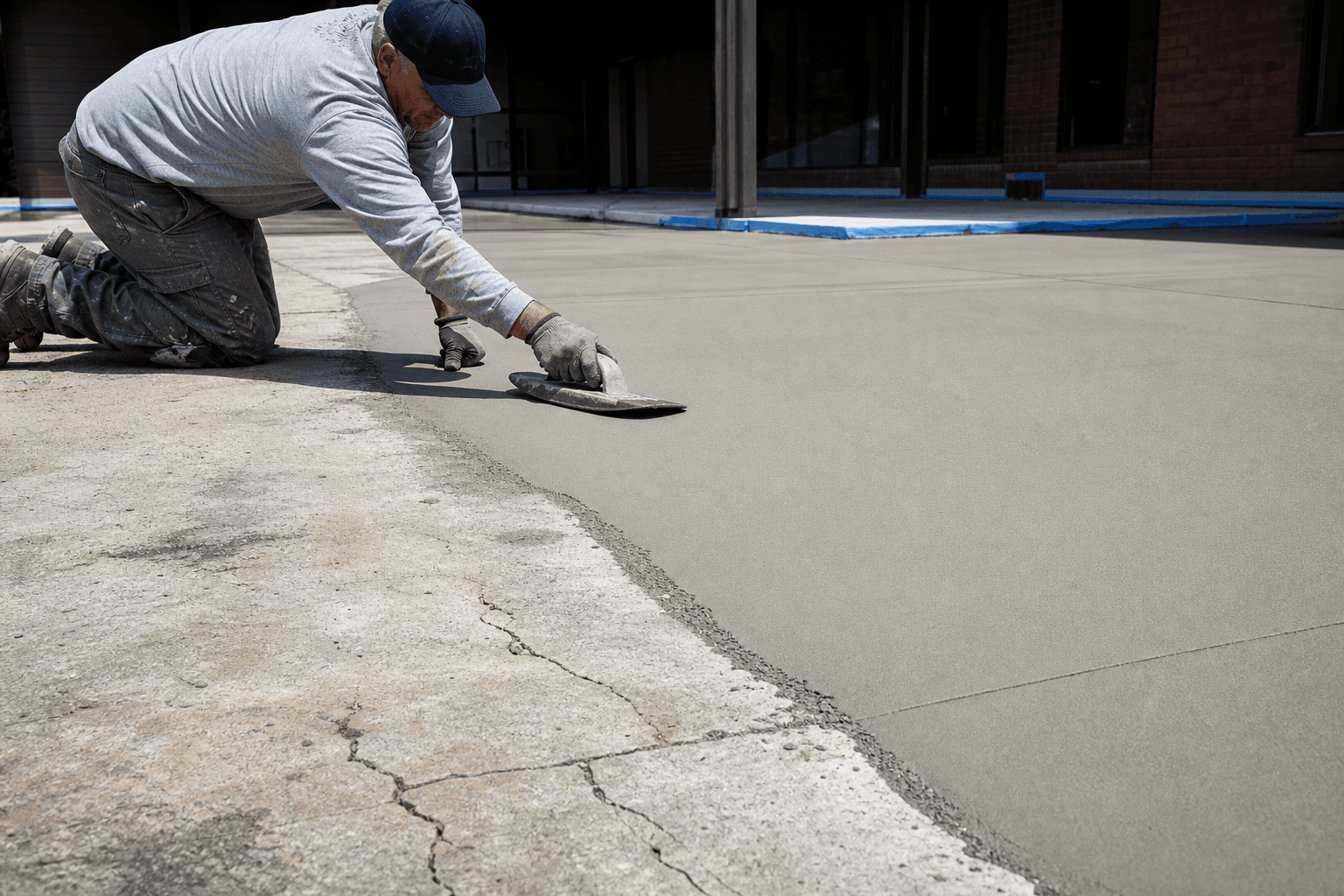
Concrete resurfacing applies a fresh overlay layer to an existing slab that's worn, stained, pitted, or scaled — but still structurally sound underneath. The overlay bonds to the existing concrete and gives you a fresh, level surface at a fraction of the cost of slab replacement. The key is an honest structural assessment first: resurfacing fixes surface problems, not structural ones. If your slab needs replacement, we'll tell you that, not take your money for a resurfacing job that won't hold.
What's included
- Structural soundness assessment — we won't resurface a slab that needs replacing
- Diamond grinding or shot blasting to create mechanical bond for the overlay
- Crack and spall repair before overlay application
- Polymer-modified or epoxy-based overlay application
- Surface finishing and texture
- Sealer or topcoat for protection and durability
When you need this service
Concrete that's too far gone for sealing but structurally sound under the surface damage
Driveway or patio with significant surface scaling, worn finish, or multiple shallow cracks
Garage or basement slab with surface pitting, exposed aggregate, or old failed coatings
Commercial floor that needs a fresh, clean surface without the disruption of full slab removal
Our process
Structural assessment: we tap-test, visually inspect, and assess whether the slab can support an overlay
Diamond grinding or shot blasting to remove the weak surface layer and create a mechanical bonding profile
Repair cracks and fill voids — these need to be addressed before the overlay goes down
Apply the polymer-modified or epoxy overlay in controlled lifts
Surface finish and texture as specified
Protective sealer or topcoat application
Why choose Elite Epoxy for concrete resurfacing
- We assess structural soundness before quoting — we won't take your money on a job that's going to fail
- Both polymer-modified and epoxy overlay systems available depending on the application
- Cost-effective alternative to slab replacement in appropriate conditions
- Can incorporate colour and finish options for an upgraded look
- Spec'd for BC Interior freeze-thaw conditions — the wrong overlay product fails quickly here
We install concrete resurfacing throughout Kamloops and the surrounding Thompson Okanagan region. See all areas we serve →
When resurfacing is the right call — and when it isn't
Concrete resurfacing occupies a specific and well-defined role: it's appropriate for concrete that is structurally intact but has surface-level problems that are beyond what sealing can address. The most common candidates are driveways and exterior concrete with freeze-thaw surface scaling, garage and basement slabs with pitting and surface wear from years of use, commercial floors with old adhesive residue or worn surface from constant traffic, and slabs where a previous coating has failed and the concrete surface underneath has degraded.
Resurfacing is not appropriate for slabs with structural cracking — cracks that are wider than 3–6mm, that show vertical displacement between sections, or that are actively growing from settlement or subgrade movement. An overlay applied over a structurally moving joint will crack in the same location within months. It's also not a solution for slabs that are heaved, buckled, or have significant level changes — overlay thickness is typically 3–10mm, which isn't enough to correct meaningful level differences.
We assess this honestly. Our interest is in doing work that lasts, not in taking a job that's going to fail and leave a bad result with your name on it. If your slab needs replacement, we'll tell you, and we'll give you a clear explanation of why.
Technical DetailPolymer-modified overlays vs. epoxy overlay systems
The two main resurfacing system categories work differently and suit different applications. Polymer-modified cementitious overlays are cement-based compounds with polymer additives — typically acrylic or vinyl — that improve flexibility, adhesion, and water resistance compared to plain cement. They're typically applied at 3–6mm thickness, can be textured, stamped, or stained, and bond well to properly prepared concrete. They're the common choice for exterior concrete — driveways, walkways, pool decks — because they handle outdoor exposure and freeze-thaw cycling well.
Epoxy-based overlay systems use a two-part epoxy as the binder rather than cement. They bond more aggressively to concrete, achieve higher compressive strength than polymer-modified overlays, and can be thinner while maintaining structural integrity. Epoxy overlays are often used in commercial and industrial settings where strength and chemical resistance matter — and they can be finished with a decorative flake broadcast or topcoated with polyaspartic for a premium result.
The choice between systems depends on the application, the slab condition, the finish goal, and the environment. Exterior driveways and patios that need to handle freeze-thaw usually go with a polymer-modified system. Interior commercial and residential floors that will get a decorative topcoat system often go with an epoxy overlay. We assess and recommend based on your specific slab and what you're trying to accomplish.
Technical DetailPreparing the slab for resurfacing: why the bond is everything
A resurfacing overlay is only as good as its bond to the existing concrete. If the overlay doesn't fully bond to the substrate, it will delaminate — and delamination in an overlay system is a significant failure that's difficult and expensive to repair. Getting the bond right is the entire point of surface preparation.
We open the existing surface with diamond grinding or shot blasting to achieve the required concrete surface profile for the overlay system. This removes the weak, carbonated surface layer that forms on older concrete, opens the pore structure so the overlay binder can penetrate, and eliminates any remaining sealer, contamination, or old coating material. Any of these left on the surface creates a bond break.
Cracks are addressed before overlay application. Cracks that are filled after grinding but before the overlay goes down become part of the repaired surface. Cracks that are ignored and covered by the overlay remain active and telegraph through the overlay material as the concrete moves. We route and fill cracks with appropriate semi-rigid or rigid filler before any overlay goes on.
Common epoxy floor questions
Everything you want to know about epoxy floors before picking up the phone.
A professionally installed epoxy floor typically lasts 10–20 years with normal use. Garage floors in harsh climates like Kamloops can expect 10–15 years with proper maintenance.
Your epoxy floor won't
coat itself.
Call us or fill out the form and we'll get back to you the same day. Free on-site quotes with no obligation.