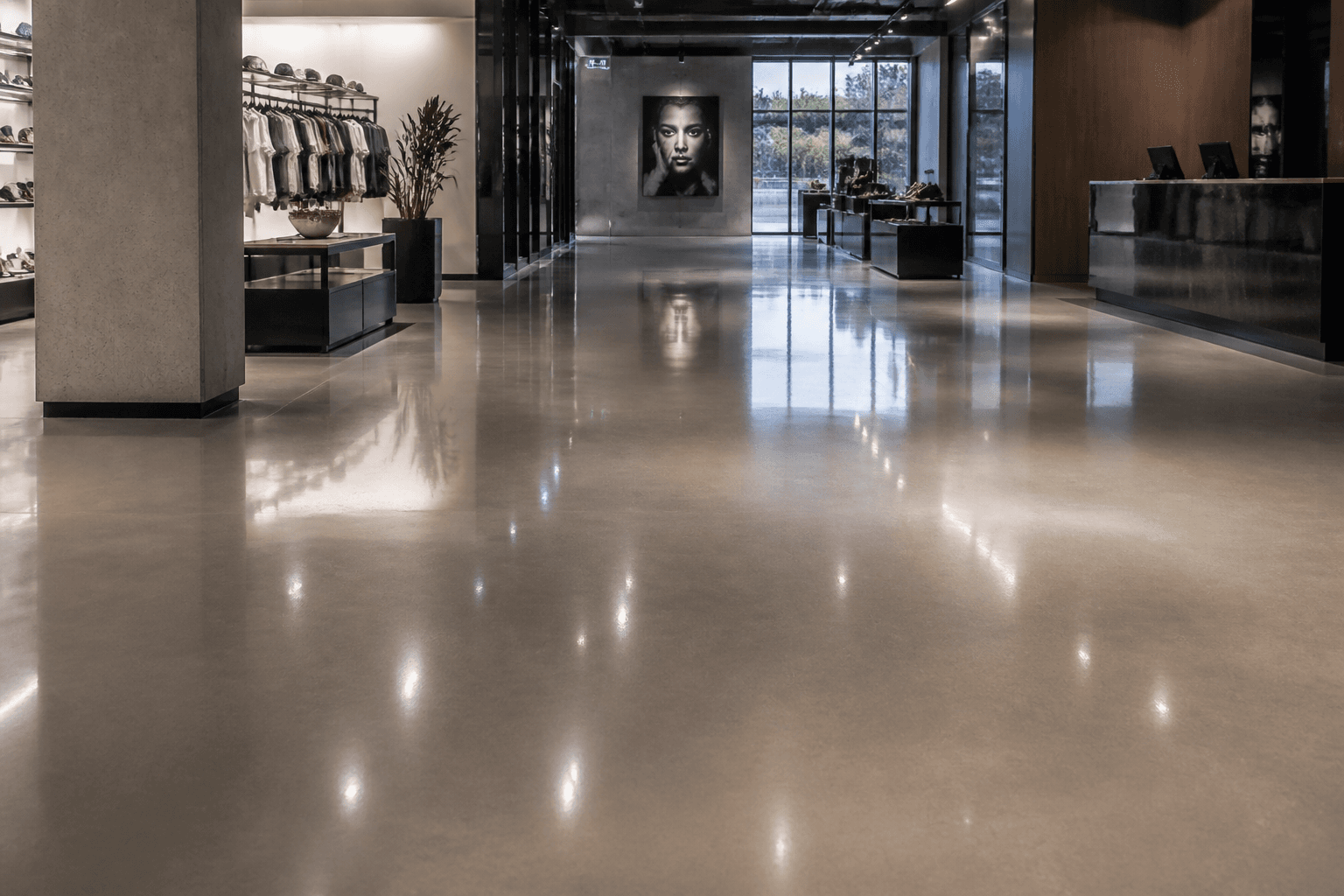
Polished Concrete
in Kamloops, BC
Polished concrete is a mechanical process, not a coating. We grind the slab through progressively finer diamond tooling stages — from coarse aggregate removal through fine polishing grits — while applying a chemical densifier that hardens and seals the concrete at the molecular level. The finished floor is the concrete itself, processed to a smooth, light-reflective surface. There's no film layer on top, which means nothing to peel, nothing to recoat, and a floor that becomes easier to maintain over time rather than harder.
What's included
- Slab assessment and aggregate exposure selection (cream, salt-and-pepper, or full stone)
- Coarse diamond grinding to remove surface paste and expose aggregate
- Progressive grit polishing through medium and fine stages
- Chemical densifier application at mid-grit stage
- Final burnishing to target sheen level (matte, satin, or high-gloss)
- Penetrating stain guard sealer
- Maintenance guide specific to polished concrete care
When you need this service
Retail or commercial space wanting a clean, reflective floor with minimal long-term maintenance
Modern residential space with exposed concrete aesthetic — open-plan, loft, or contemporary home
Warehouse or industrial space needing a dust-free, hardened floor without a coating system
Any space where you want a floor that ages well and doesn't require periodic recoating
Our process
Slab assessment: we check for cracks, aggregate quality, and whether the slab polishes well — not every slab does
Coarse grinding (16–50 grit) to remove surface paste and set the aggregate exposure level
Progressive polishing through medium grits (100–400) to develop reflectivity
Chemical densifier application — applied at the 200–400 grit stage, soaks in and hardens the concrete
Fine polishing (800–3000 grit) to achieve target sheen — satin, semi-gloss, or high-gloss
Penetrating stain guard sealer to protect the polished surface from staining without adding a film
Why choose Elite Epoxy for polished concrete
- True mechanical polish — not a coating that peels
- The densifier makes the concrete surface harder than it started, not just shinier
- No film layer to reapply — maintenance is sweeping and occasional damp mopping
- Aggregate exposure level is your design choice — cream finish (smooth), salt-and-pepper (fine aggregate), or full aggregate exposure
- Works for both commercial installs and modern residential projects in Kamloops
We install polished concrete throughout Kamloops and the surrounding Thompson Okanagan region. See all areas we serve →
How concrete polishing actually works
Concrete polishing is a multi-step mechanical process that progressively refines the concrete surface from rough to smooth to reflective. It's done entirely with diamond-segmented tooling — grinding tools with industrial diamonds embedded in a metal or resin bond — mounted on planetary polishing machines.
The process starts with coarse tooling (typically 16–30 grit metal-bond diamonds) that cuts aggressively into the concrete surface, removing the surface paste layer and exposing the aggregate beneath. The aggregate exposure level — how deep we cut — determines whether you get a cream finish (just surface paste, no aggregate visible), a salt-and-pepper finish (fine aggregate exposed), or a full aggregate finish (large aggregate stones visible, similar to terrazzo). This is a design decision made upfront, because you can always go deeper but you can't go back.
After coarse grinding, we step through progressively finer diamond grits — 50, 100, 200, 400 — each step removing the scratch pattern from the previous one and developing reflectivity. At the 200–400 grit stage, chemical densifier is applied to the surface. The densifier — a liquid potassium or sodium silicate — soaks into the concrete and reacts with calcium hydroxide in the cement paste, forming additional calcium silicate hydrate. This chemical reaction increases the surface hardness and reduces porosity without adding a visible film. The concrete literally becomes harder during the polishing process.
Final polishing with fine grits (800, 1500, 3000) develops the sheen and reflectivity of the finished surface. A penetrating stain guard sealer is applied at the end — it soaks into the now-dense surface and provides stain resistance without creating a film layer that could wear, peel, or require stripping.
Aggregate exposure: what each level looks like and why it matters
The aggregate exposure level is the single biggest design decision in polished concrete. It determines the visual character of the finished floor more than the sheen level does, and it can't be changed without starting over from coarse grinding. Understanding the options before we start is important.
Cream finish means we stop before exposing the aggregate — the finished surface shows the smooth concrete paste layer with some fine micro-texture. This gives a consistent, clean look with no stone variation. It polishes to the highest reflectivity because the surface is uniformly dense. Cream finish concrete looks almost artificial in its consistency — some people love it, some find it too uniform. It only works on concrete that was finished to a consistently smooth level during the original pour.
Salt-and-pepper finish exposes the fine aggregate — small crushed stone particles that are distributed through the concrete mix. The result is a surface with visible texture variation that still looks clean and polished. It's the most popular choice in commercial settings because it accommodates normal variation in the original pour quality and gives a more natural look than cream finish.
Full aggregate exposure reveals the larger coarse aggregate stones — the rocks in the concrete mix. The result looks similar to terrazzo or exposed aggregate and is visually dramatic. It requires a deeper grind (more material removal) and works best on concrete with a consistent, visually interesting aggregate. Not every slab has aggregate worth exposing.
Polished concrete vs. coated concrete: how to choose
Polished concrete and coated concrete floors — epoxy, polyaspartic, or flake systems — are often compared as alternatives for the same space. They're genuinely different products with different strengths, and the right choice depends on the specific application.
Polished concrete wins on long-term maintenance: there's no coating to wear, peel, or reapply. The surface gets easier to clean over time as the densified concrete polishes further with foot traffic. It also wins on aesthetics for spaces where an exposed-concrete look is the design intent — modern retail, industrial-chic residential, contemporary commercial. And it wins on durability in a specific sense: you can't delaminate or peel something that isn't there.
Coated concrete wins on chemical resistance: a properly specified epoxy and polyaspartic system provides significantly better protection against oils, solvents, and staining agents than polished concrete, even with a stain guard sealer. It wins on colour and customization: coating systems give you complete control over the floor's colour, texture, and decorative character in a way polished concrete doesn't. And it wins in garage and industrial applications where vehicle traffic, chemical exposure, and mechanical loads are significant — polished concrete isn't the right spec for a working garage floor.
We're happy to install either system. We'll give you an honest recommendation based on the space, the use, and what you're trying to accomplish — not based on which has a higher margin.
Common epoxy floor questions
Everything you want to know about epoxy floors before picking up the phone.
A professionally installed epoxy floor typically lasts 10–20 years with normal use. Garage floors in harsh climates like Kamloops can expect 10–15 years with proper maintenance.
Your epoxy floor won't
coat itself.
Call us or fill out the form and we'll get back to you the same day. Free on-site quotes with no obligation.